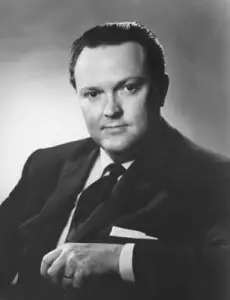
A note on sourcing: Warren (1911–1960) was a house baritone of the Metropolitan Opera, the preeminent Verdi baritone of his generation. He was not a stadium celebrity or the founder of a charity. In keeping with the project's practice for artists of this kind, the "mass audience" and "philanthropy" sections are built from his documented history: the Met's radio and early television broadcasts, Toscanini's 1944 Red Cross benefit at Madison Square Garden, his appearance in a Hollywood musical, his 1958 tour of the Soviet Union, and the foundation set up in his name after his death. No concerts or charities have been invented. Facts and dates come from the New York Public Library's Leonard Warren Papers finding aid, Wikipedia, Encyclopaedia Britannica, the Metropolitan Opera archives, the AFI Catalog, the New York Philharmonic archives, MusicWeb International and Classic FM.
On the night of March 4, 1960, the old Metropolitan Opera House on Broadway and Thirty-Ninth Street felt the way it always did on a great Verdi night. The gold curtain hung heavy in the warm air of the auditorium. The boxes of the Diamond Horseshoe glittered with jewels and opera glasses. Up in the Family Circle, the students and clerks and immigrant pensioners who had climbed the long stairs leaned out over the brass rails, as they had for decades. The opera was La forza del destino, Verdi's sprawling tale of vengeance and fate, and the cast was the kind only the Met could gather. Renata Tebaldi sang Leonora, the young Thomas Schippers conducted, and Don Carlo di Vargas, the nobleman who pursues his sister's lover across half of Europe, was sung by Leonard Warren. He was the Bronx-born son of a Russian-Jewish furrier, and for twenty years he had been the reigning Verdi baritone of the age. Only three nights before he had sung the title role of Simon Boccanegra on the same stage. He was forty-eight, at the height of his powers, and the audience knew it.
The moment the house was waiting for came in the third act. On a battlefield in Italy, Carlo is left alone with a sealed packet that his wounded friend has begged him never to open. Verdi gives him a recitative, "Morir! Tremenda cosa!" ("To die! A momentous thing!"), and then the great aria "Urna fatale del mio destino," in which honor fights with suspicion in long, rising phrases that test a baritone's breath, legato and nerve. Witnesses agreed afterward that Warren had seldom been in better form. His voice moved through the long lines with a dark, even beauty and rose through the cadenzas to the climactic high notes with complete confidence. When the last phrase faded, the applause rolled down from the galleries and up from the orchestra stalls. It was the ovation of an audience that knew it had just heard one of the defining performances of the century.
The scene went on. The singer playing the Surgeon came in to announce that Alvaro would live. Warren, as Carlo, was meant to tear open the packet and cry out in triumph. He did not. He pitched forward onto the stage. Some witnesses said he called for help and others that he fell without a sound. Confusion swept the house, the curtain came down, and backstage doctors worked over him with oxygen while the audience waited. At about 9:55 that evening, the general manager Rudolf Bing stepped before the curtain and told the stunned house that Leonard Warren was dead, of what proved to be a massive cerebral hemorrhage. Bing called it one of the saddest nights in the history of the Metropolitan, and he cancelled the rest of the performance. Warren had died within minutes of singing, at the peak of his art, an aria about the terror of death and the pull of fate. The irony was unbearable, and it fixed him in the memory of opera in a way no triumph alone could have done. Yet the irony should not hide the plainer truth of that night. Until his very last moment, the man on that stage was singing as well as any baritone ever has.
What made that last aria possible was one of the most remarkable baritone instruments ever recorded, and a technique built through years of hard, solitary work. Warren's voice was big. It filled the vast horseshoe of the old Met without strain. But what struck connoisseurs was less its size than its evenness. From the dark, cello-like bottom of the range up to a top that rang out with a tenor's brilliance, the tone stayed the same color and the same weight, with no audible joins between registers. Critics have long described it as a well-produced voice of naturally wide range, with secure high notes and a smooth, rich timbre throughout. In the language of voice pedagogy, Warren had mastered the passaggio, the zone around E-flat to F-sharp above middle C where baritones must change gear into the upper register. He did it so seamlessly that his top notes seemed to grow out of his middle voice rather than break away from it.
That top was the envy of his rivals. Verdi wrote his great baritone roles high, around the treacherous upper fifth of the voice, and the tradition of the period added interpolated top notes as a matter of course. Warren's A-flats and A's had a free, ringing quality, carried on a column of breath so steady that he could swell or diminish a note at will. This is the old Italian art of messa di voce. He could have made a career on those high notes alone, but contemporaries noted that he never overused them. He treated them as dramatic punctuation rather than athletic display.
The breath was the engine. Warren was a broad-chested man, and he built breath control capable of spinning out Verdi's longest phrases, such as the slow arch of "Urna fatale" or the quiet entreaties of Rigoletto's "Miei signori, perdono, pietate," without a visible gasp. Just as important was his control of soft singing. In an age that prized volume, he could reduce that huge voice to a floated mezza voce and keep its core and color, so that a pianissimo still carried to the back of the Family Circle. Wherever he could, he chose resonance and focus over force.
None of this came easily. Warren did not grow up in a conservatory. He took his first formal lessons as a teenager at the Greenwich House Music School, while his family doubted that a singing career was realistic, and for years he worked in his father's fur business. In 1935 he auditioned for the Radio City Music Hall Glee Club. He hoped to become a soloist, but Robert Weede was the established baritone there, so Warren joined the chorus, alongside the future Met star Jan Peerce. During these years he studied with the vocal coach Sidney Dietch, and later reference books also list the great Verdi baritone Giuseppe De Luca among his teachers. In 1938 he became a finalist in the Metropolitan Opera Auditions of the Air. The Met was impressed by the raw quality of his voice, signed him, and gave him a stipend to study in Milan with Giuseppe Pais and Riccardo Picozzi. He came home knowing only a handful of arias and having never sung a complete opera on stage. What followed was a painstaking apprenticeship conducted in public, as he built his technique and his acting role by role over the next two decades.
Warren's stage debut, on January 13, 1939, was a modest one. He sang Paolo, the scheming courtier in Simon Boccanegra, while the title role belonged to Lawrence Tibbett. His progress at the Met was slow but steady. He learned the house and the repertoire, and he waited. By the mid-1940s he had become the company's leading Verdi baritone, and three roles above all mark the shape of his art.
The first was Rigoletto, the hunchbacked court jester. It was the role most completely identified with him, and he returned to it throughout his career, including in RCA Victor's 1950 complete recording with Erna Berger and Jan Peerce. Rigoletto demands two voices at once: the snarling, sardonic bite of the jester, and the overflowing tenderness of a father terrified for his daughter. Warren's genius lay in pacing. In the great monologue "Pari siamo" he moved from muttered bitterness to an almost hallucinatory rage and then down to a hushed longing as he enters his home. In "Cortigiani, vil razza dannata" he let the fury break against the courtiers' indifference until it collapsed into weeping supplication. He kept the most cutting sounds for the moments the text called for them, and he never sacrificed Verdi's legato for cheap effect.
The second pillar was Simon Boccanegra, the role in which he had made his debut as a courtier and which he eventually claimed as his own in the title part. It was also the last role he sang complete, on March 1, 1960. Boccanegra is a corsair who becomes Doge of Genoa and a father who rediscovers his lost daughter, and Verdi's revised score asks for grandeur of spirit more than vocal display. In the Council Chamber scene, when Simon silences a brawling mob with the great appeal "Plebe! Patrizi! Popolo," Warren's voice turned into an instrument of moral authority, broad and noble and commanding without ever shouting. In the death scene, as the poisoned Doge blesses his daughter, he thinned the voice down to a glowing thread. Surviving live recordings preserve some of the most humane singing of his generation.
The third era shows Warren reaching into darker territory. As his voice matured he took on roles that demanded psychological complexity rather than heroic warmth. One was Iago in Otello, the role of his La Scala debut in 1953. Here the beauty of his tone became a weapon, the smooth seducer's sound behind which Iago's nihilism hides. Another was Scarpia in Tosca, Puccini's sadistic police chief, recorded with Zinka Milanov and Jussi Björling. The peak of this late period came on February 5, 1959, when he sang the title role in the Met's first-ever production of Verdi's Macbeth. The production had been meant for Maria Callas, and her feud with Bing had become a scandal. When Leonie Rysanek replaced her as Lady Macbeth, attention fell all the more on Warren. His Macbeth was a weakling consumed by ambition, haunted by visions, wavering between guilt and ferocity, and it became one of his greatest successes. The RCA studio recording made the same month with Rysanek, Carlo Bergonzi and Jerome Hines under Erich Leinsdorf preserves it. Skeptics had once dismissed Warren as a gorgeous voice with a stiff actor attached. Macbeth answered them. The late Warren could act with his voice, using color, word and silence to dramatize a man's inner collapse.
Warren's career coincided with the moment when opera in America stopped being a ritual of the wealthy and became, for a time, part of national popular culture. He was ideally placed to carry that change. He belonged to the first generation of American-born singers to build truly international careers at the Met, and his success helped secure their place in a company long dominated by European stars. Every Saturday afternoon the Met's radio broadcasts carried the voices of the house into farmhouses, kitchens and parked cars across the continent. Millions of listeners who had never owned evening clothes came to know Rigoletto's curse and Boccanegra's appeal for peace as well as any box-holder did.
Television pushed this further. On November 29, 1948, the Met's opening-night Otello became the first live television broadcast from the Metropolitan Opera, with Ramón Vinay as Otello, Licia Albanese as Desdemona and Warren as Iago. For the first time, an American family could watch, not just hear, a complete Verdi tragedy unfold in the actual opera house. Warren's Iago became one of the first operatic villains to enter American living rooms in moving images.
The most spectacular mass event of his career came four years earlier. On May 25, 1944, in the middle of the war, Arturo Toscanini led the combined forces of the NBC Symphony and the New York Philharmonic in a benefit for the American Red Cross at the old Madison Square Garden, an arena built for prizefights and political rallies. The program included the last act of Rigoletto, with Warren as the jester, Milanov as Gilda, Peerce as the Duke, Nicola Moscona and Nan Merriman. In a building that usually echoed with boxing crowds, a vast and socially mixed audience heard the young Warren carry Verdi's climactic tragedy under the most exacting conductor alive. The concert raised about $100,000 for the war effort, and the recording has stayed in circulation for eighty years.
Hollywood came calling the same year. In 20th Century Fox's Technicolor musical Irish Eyes Are Smiling, released in late 1944, Warren and the mezzo-soprano Blanche Thebom made their feature-film debuts, performing operatic interludes amid the film's popular songs. Contemporary reviewers singled out their contributions as distinguished. The sight of a Met baritone on movie-palace screens across America showed that operatic singing could hold its own in the mass entertainment of the age.
The sociological meaning of all this was profound. Through radio, television, cinema and arena concerts, Warren helped turn opera from something one attended into something one simply encountered. It reached a public that had never been asked to dress up for it.
For a singer so rooted in Verdi, Warren was strikingly open to work beyond the standard repertoire. During the 1940s he extended his reach to Mexico City, Buenos Aires and Brazil, building a following in Latin America. He also championed contemporary American music. His papers record his close involvement in the world premiere of Norman Dello Joio's cantata The Lamentation of Saul, a dramatic setting of the biblical story for baritone and instruments. In taking it on, Warren put the same seriousness into a living American composer that he brought to Verdi. Alongside his operatic work he recorded lighter material for RCA, and through broadcasts and film he moved easily between the opera house and popular entertainment. Some purists considered that unbecoming for an artist of his stature. Warren's answer, in practice, was that a voice trained to its limits ought to be used wherever it could reach listeners.
His most important collaboration was diplomatic. In May 1958, at the height of the Cold War, Warren toured the Soviet Union under the management of the Hurok organization. It was one of the first postwar appearances there by a prominent American performer. Accompanied by the pianist Willard Sektberg, he gave concerts in Leningrad and Kiev that were received with enormous enthusiasm. The concerts were recorded live, and RCA later released them as Leonard Warren on Tour in Russia. The son of Russian immigrants, singing Handel, Verdi and American songs to Soviet audiences in the years after Stalin, became a small but resonant symbol of music crossing a border that politics had sealed.
His charitable work took the forms available to a working opera singer of his time, namely benefit performances rather than foundations. The Toscanini Red Cross concert is the best-documented example. His fullest philanthropic legacy came after his death. In 1986 his sister, Vivien Warren, and Barrett Crawford established the Leonard Warren Foundation to promote his legacy and to support young singers. The foundation later sponsored his authorized biography by Mary Jane Phillips-Matz and a commemorative edition of his recordings. Through it, the voice that had come from a Bronx fur shop and a Radio City chorus line continues to help other young singers who lack money and connections take the first steps he once took alone.
More than sixty years after his death, Warren's recordings remain one of the fixed points by which Verdi baritone singing is measured. They include the 1950 Rigoletto, the Il trovatore, Aida and Tosca with Milanov and Björling, the La forza del destino with Milanov and Giuseppe Di Stefano, the 1959 Macbeth, and a large archive of live Met broadcasts. Students preparing "Pari siamo," "Eri tu," "Il balen del suo sorriso" or "Urna fatale" sooner or later meet Warren's versions. The experience is both inspiring and intimidating. His recordings show what an evenly produced voice can do across the whole range, how a high note can serve a phrase instead of interrupting it, and how much tenderness a big voice can hold. Mary Jane Phillips-Matz's biography calls him history's most notable interpreter of Verdi, and many listeners would still agree.
His career also anticipated how opera reaches the world today. Every Met Live in HD transmission to cinemas, every streamed archive broadcast and every opera excerpt watched on a phone traces back to the experiments in which Warren took part: the Saturday radio broadcasts, the first live telecast from the Met in 1948, and the Madison Square Garden benefit. He was one of the first great opera singers whose art was known to most of its admirers through a microphone and a camera rather than a seat in the house.
In the end, what did Leonard Warren give to human experience? He showed that the most aristocratic of art forms could belong to anyone. He did not learn that from privilege. He worked it out himself, in a fur warehouse, in a music-hall chorus, and in years of self-correction under the hardest scrutiny in opera. He gave Verdi's fathers, kings and villains a voice of such beauty and moral weight that their suffering became our own. His last aria asked what it means to die and to be at the mercy of fate. He answered it with perhaps the finest singing of his life, and then he fell silent. A voice like his outlives the man. It goes on in the grooves of old records and the hiss of broadcast tapes, and in every young baritone who tries for that seamless climb toward a high note and hears Warren already standing there. Few artists have given more of themselves to their art, and none has left the stage more completely in the middle of it.