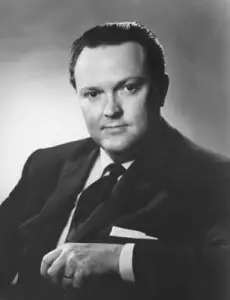
The 1994–1995 season at the Royal Opera House, Covent Garden, began much like any other. The red velvet and gilded boxes were the same, and so was the heavy curtain behind which Verdi, Wagner, and Puccini had sounded for more than a century. Yet this time the playbill carried a title that many regular patrons would once have thought impossible within those walls: Gilbert and Sullivan’s The Yeomen of the Guard. For decades the Savoy operas had been treated as “light” entertainment, adored by the public but regarded as second-rate by the musical establishment. They belonged to touring stages, provincial theatres, and amateur societies, not to Britain’s foremost opera house. Then Welsh National Opera’s production of Yeomen became the first Gilbert and Sullivan production ever staged at the Royal Opera House, with Donald Adams as Sergeant Meryll.
The symbolism of that moment is hard to overstate. Adams was in his sixties, and he had given nearly half a century to exactly this repertoire, the one so often looked down upon. He had entered the world of the Savoy operas when the D’Oyly Carte Opera Company still held sole command of them, and for many years he had been the face and voice of their great bass roles. Now he stood on the stage once graced by Chaliapin and Callas, in the role of an old soldier of the Tower of London, and his very presence testified that this genre and this tradition were worthy of the world’s finest stages.
Sergeant Meryll is not the showiest part in the Gilbert and Sullivan canon. He has none of the dazzling comedy of the Mikado or the demonic grandeur of Sir Roderic in Ruddigore. He is a character role: a veteran, a father, a man of duty drawn into a risky plot to save a wrongly condemned prisoner. Its power lies not in effects but in dignity, in the ability to make human truth audible through the conventions of the genre. That was precisely the task best suited to the mature Adams. By then his voice had lost some of its youthful freshness, but it had gained depth, tonal wisdom, and the particular precision of inflection that comes only from decades of living inside a text.
The audience that evening witnessed more than a performance. They saw the wall between “high” and “low” art begin to crack, and standing in that crack was a man who had spent his whole life proving the wall unnecessary. The recordings he made with Charles Mackerras and Welsh National Opera, including the Mikado, the Pirate King, Dick Deadeye, and Sergeant Meryll, gave this late triumph a lasting form. If one had to choose a single moment in which every thread of his biography converged, the singing actor, the guardian of tradition, and its renewer, it would be that evening at Covent Garden. The genre he had served finally entered the temple, and it entered alongside him.
To understand why Adams became a benchmark, one must begin at the source. Born in Bristol in 1928, he was educated at the Bristol Cathedral School, where he sang as a cathedral chorister and, at sixteen, played Thomas Becket in Murder in the Cathedral. These two beginnings, choral and theatrical, defined his entire artistic nature. Choral singing trains a child in clean intonation, even breath, and the discipline of subordinating one’s voice to a shared line. Theatre teaches something else: every word must carry meaning, every gesture must reveal character. Adams was that rare artist in whom both disciplines fused into a single mechanism.
His Italian training was decisive. In London he studied with Rodolfo Melle, who had sung at La Scala alongside the tenor Aureliano Pertile. Melle taught him to sustain the vowels of a word before arriving at the consonants, which, Adams said, gave the voice a lovely line, and he kept practising those lessons until the end of his life. Behind this modest-sounding principle lies the whole philosophy of Italian bel canto. The voice lives on the vowel. It is on the vowel that the vocal folds vibrate freely and the resonators, the pharynx, the mouth, and the “mask” of the face, amplify the sound. Consonants interrupt that flow. A singer who lunges at the consonant too early chops the phrase into pieces. A singer who holds the vowel until the last instant and then places the consonant quickly and precisely produces an unbroken cantilena, a true legato.
For an interpreter of Gilbert, this technique was especially valuable. Gilbert’s texts teem with wordplay, internal rhymes, and breakneck patter. Half of their worth is verbal: if the audience cannot hear the words, the joke dies. Many singers in the genre sacrificed voice for diction and turned singing into half-speech. Adams did the opposite. He built his sound on an Italian vocal foundation and slotted the consonants in at the last moment before the next vowel. The result was a text of crystalline clarity, delivered without any loss of timbre or projection. This is the balance every bass-baritone seeks: a sound dark and full enough for weight, yet focused enough for intelligibility.
His natural instrument was formidable. It was the music-hall star Arthur Lucan who urged Adams, with his booming bass voice, to combine his singing and acting and audition for the D’Oyly Carte in 1951. But power alone decided nothing. Large bass voices often sound ponderous, with a closed or overpressed tone, especially when the singer chases richness for its own sake. Adams, by contrast, kept flexibility and mobility in his sound, which let him move from the Mikado’s thunderous pronouncements to a light, ironic aside within a single phrase. This is the essential point: his strength was acoustic and semantic, not muscular. He did not press; he directed. He did not shout over the orchestra; he cut through it with clarity of articulation. Forty years after his lessons with Melle, critics were still hearing in his singing the very “line” the Italian teacher had instilled.
The first great era of Adams’s career, his years with the D’Oyly Carte, began on humble rungs. He was hired as a chorister in 1951, soon took small roles such as Bill Bobstay in H.M.S. Pinafore and Samuel in The Pirates of Penzance, and eventually understudied twenty-six roles. That apprenticeship, learning the whole repertoire from the inside, shaped him as an ensemble artist. Then came the turning point. When the veteran Darrell Fancourt retired at the end of the 1952–53 season, Adams became the company’s principal bass-baritone, regularly playing Dick Deadeye, the Pirate King, Colonel Calverley, the Earl of Mountararat, the Mikado, Sir Roderic, Sergeant Meryll, and Arac. Succeeding Fancourt, a legend who had sung these roles for decades, was a heavy burden, and many in his place would simply have copied their predecessor. Instead, though he admired Fancourt, Adams asked Bridget D’Oyly Carte whether he could create his own characterisations. She agreed, promising to tell him if he overstepped the mark. That request says a great deal about him: respect for tradition never meant slavish repetition.
The central creation of this era was the Mikado. Gilbert’s Emperor of Japan is at once chilling and comic, a ruler who speaks with genial smiles about making the punishment fit the crime and relishes his ingenious penalties. He must be played so that the audience laughs while feeling a faint shiver. Adams found that balance. His majestic, rolling voice gave the character a frightening monumentality, while his flawless comic timing turned him into a satire of complacent power. He recorded the Mikado with the D’Oyly Carte for Decca in 1958 and played the title role in the company’s 1966 film of The Mikado. That film, preserving his bearing and manner, made his Mikado canonical for generations of viewers.
The second key creation was Sir Roderic Murgatroyd in Ruddigore, the ghost who steps down from his portrait to torment his descendants. Here Adams revealed another side of his art, dark and almost operatically romantic. The ghosts’ music in Ruddigore is among Sullivan’s most “serious” writing, a parody of Gothic opera that itself demands genuine vocal power and sustained line. His Italian schooling served him perfectly: the dark, steady sound carried the atmosphere of dread while the words remained clear. He recorded Sir Roderic for Decca in 1962 and voiced the character in the Halas and Batchelor animated version of Ruddigore.
The third and boldest era began when Adams was past fifty. Rather than settling comfortably into his beloved genre, he entered the world of grand opera, not as an honoured guest but as a full participant. His Baron Ochs in Der Rosenkavalier for Welsh National Opera in 1990 was hailed by The Independent as a triumph: at sixty-two, no longer in his freshest voice, he more than compensated through the marvellously subtle way he handled the text. Ochs is one of the most demanding bass roles in the repertoire, enormous in length, requiring stamina, deep low notes, and comic gifts combined with coarseness and even vulgarity. Skeptics might have said that an artist from the “light” genre could never manage Richard Strauss. Adams answered with what he did better than anyone: he made the text his weapon. In the same way he entered the worlds of Berg, Janáček, and Britten, proving that his mastery was not a narrow specialism but a universal culture of word and sound.
In the mid-twentieth century, British musical culture was split by an invisible but very solid border. On one side stood “serious” opera with its houses, critics, and patrons. On the other stood Gilbert and Sullivan, operetta, and music hall, loved by millions but filed by the establishment under entertainment. Adams’s career was a long, patient erosion of that border, from both directions.
Even before the D’Oyly Carte, he had passed through the whole school of popular theatre. After national service, during which he ran the Army Repertory Theatre at Catterick Camp, he returned to acting and music-hall work, spent two years as leading man at the Little Theatre in Great Yarmouth, sang in a quartet called The Regal Four, and appeared in pantomime at the Euston Theatre in King’s Cross. This was art without pretension, addressed to the widest public, and Adams never disowned that past. On the contrary, it gave him the most important thing of all: the ability to make direct contact with an audience, to make every spectator feel the show was being played for them.
The decisive step toward a mass audience was founding his own company. From 1969 he performed full-time with Gilbert and Sullivan for All, the touring company he had founded several years earlier with Norman Meadmore and the tenor Thomas Round. It recorded nine of the operas and toured the British Isles, North America, Australasia, and the Far East. The name itself was a manifesto: “for all.” It referred not only to geography but to social access. A compact touring troupe could travel where the great operatic machine never would and bring this repertoire to audiences who might never have crossed an opera-house threshold.
Recordings and the screen played an enormous role. The Decca records with the D’Oyly Carte travelled into homes where they were played over and over, turning Gilbert and Sullivan into part of domestic culture. In 1963 he joined other D’Oyly Carte artists on a Reader’s Digest collection, The Best of Gilbert and Sullivan. Barred by contract from recording his D’Oyly Carte roles, he sang Ko-Ko, the Sergeant of Police, Private Willis, Don Alhambra, Bunthorne, and Major Murgatroyd instead. Reader’s Digest sets were mailed to ordinary households far from any concert hall, making them, in effect, a mass-media channel of their era. Television followed: in 1982 he appeared in three of the Brent Walker Gilbert and Sullivan television productions, as Sir Marmaduke in The Sorcerer, Colonel Calverley in Patience, and Sir Roderic in Ruddigore.
The cultural meaning of this path lies in its two-way nature. Adams carried Gilbert and Sullivan to a mass audience around the world, and then, in his maturity, brought that same “popular” experience onto the stages of Covent Garden, Glyndebourne, and English National Opera. He showed that the line between elite and popular art runs not between genres but through the quality of performance. When an artist treats a light work with the same rigour as Strauss, the light work ceases to be light.
Adams’s willingness to work beyond familiar boundaries showed most vividly when he encountered the most radical theatre of his day. In 1983 Matthew Epstein invited him to sing the title role in Peter Sellars’s version of The Mikado in Chicago, which led to many seasons there, including Baron Zeta in The Merry Widow and the Theatre Director and the Banker in Berg’s Lulu. Sellars was known for bold and often provocative reimaginings of the classics, and to a Savoy purist the very idea of joining his Mikado might have looked like betrayal. Adams, the keeper of the canonical interpretation, took the risk and proved that a living tradition survives not through museum stillness but through its capacity to answer a new vision.
The same openness defined his work with artists from other worlds. He sang the Mikado in Los Angeles alongside Dudley Moore, the comedian, pianist, and film star. With Thomas Round he toured as W. S. Gilbert himself in Tarantara! Tarantara!, Ian Taylor’s musical about the Gilbert and Sullivan partnership. Here the circle closed: a performer who had spent his life inside Gilbert’s creations now embodied their author onstage. In December 1983 he also sang Alfred Doolittle in My Fair Lady for Scottish Opera, a role from the musical, a genre opera purists often greeted with even more suspicion than operetta.
Equally important was his collaboration with the leading conductors of the opera world. Beyond his Gilbert and Sullivan work with Mackerras, his complete recordings include Dikoj in Janáček’s Katya Kabanova (1988), Antonio in The Marriage of Figaro (1994), and Trulove in Stravinsky’s The Rake’s Progress (1995), placing him beside the most serious performers of the age. Each such project answered the skeptics: the art he served is a universal language, spoken as fluently in Savoy comedy as in Stravinsky.
On public service, honesty matters: unlike the stadium-era superstars, Adams was not known for large philanthropic campaigns, and it would be untrue to credit him with any. His generosity took another form, that of a mentor and guardian. In his last years he was president of the Cambridge University Gilbert and Sullivan Society, and he also composed and arranged music. The countless amateur societies, school productions, and student companies that stage Gilbert and Sullivan across the English-speaking world today are the true audience of his service. He built no music centres, but he helped keep alive a culture in which ordinary people still gather to sing together.
Adams’s final years were not a sunset but a continuation of flight. English National Opera engaged him many times, as Dikoj, Pooh-Bah, Alcindoro and Benoit in La bohème, the Woodcutter in Königskinder, Mumlal in The Two Widows, Quince in A Midsummer Night’s Dream, and Don Pasquale. Of his Bartolo in The Marriage of Figaro, The Times wrote that the one truly Mozart-sized portrayal was “the Dr Bartolo of the immortal Donald Adams.” He sang Antonio in the Figaro that opened the new opera house at Glyndebourne in May 1994, and his last appearance, just a month before his death, was with English National Opera in Don Pasquale. According to the obituary in The Times, his diary at the time of his death was as full as that of any leading singer half his age, and he had been especially looking forward to singing in Britten’s A Midsummer Night’s Dream at the Metropolitan Opera. He died in Norwich on 8 April 1996, at the age of sixty-seven.
For interpreters of Gilbert and Sullivan, Adams’s recordings remain what Caruso’s are for tenors: an intimidating but indispensable benchmark. A young bass preparing the Mikado, Sir Roderic, or the Pirate King inevitably listens to him, and inevitably discovers how hard it is to reproduce his apparent ease. His singing teaches the hardest lessons of all: how to sing clearly without losing the line, how to be funny without losing dignity, how to stay faithful to the text while finding one’s own voice within it. He is a living demonstration of Melle’s principle: the vowel carries the music, the consonant carries the meaning, and the true artist commands both.
His pioneering role in spreading the genre, through records, film, television, and international touring, cleared the road along which Gilbert and Sullivan travel in the digital age. Recordings once mailed to households are now available on streaming services, and the 1966 film remains a window onto an entire vanished theatrical era.
Yet Adams’s legacy is not confined to an archive. He was a man who refused to divide art into high and low, and his whole life proved the division false. The boy from the Bristol cathedral choir, the music-hall actor, Fancourt’s heir, the founder of a company “for all,” Strauss’s Baron Ochs and Covent Garden’s Sergeant Meryll were one and the same artist, bound by the same fidelity to word and sound. In the rolling depths of his bass lived old England, with its love of absurdity, wordplay, and good-humoured mockery of power and pomposity. And in those same depths sounded an eternal human truth: that laughter and dignity are not opposites, and that great art can reach anyone willing to listen. Whenever someone, in a school hall or on a student stage, steps out for the first time as the Mikado, Donald Adams stands invisibly behind them, and his voice, dark, warm, and infinitely clear, still rings out over the hall.